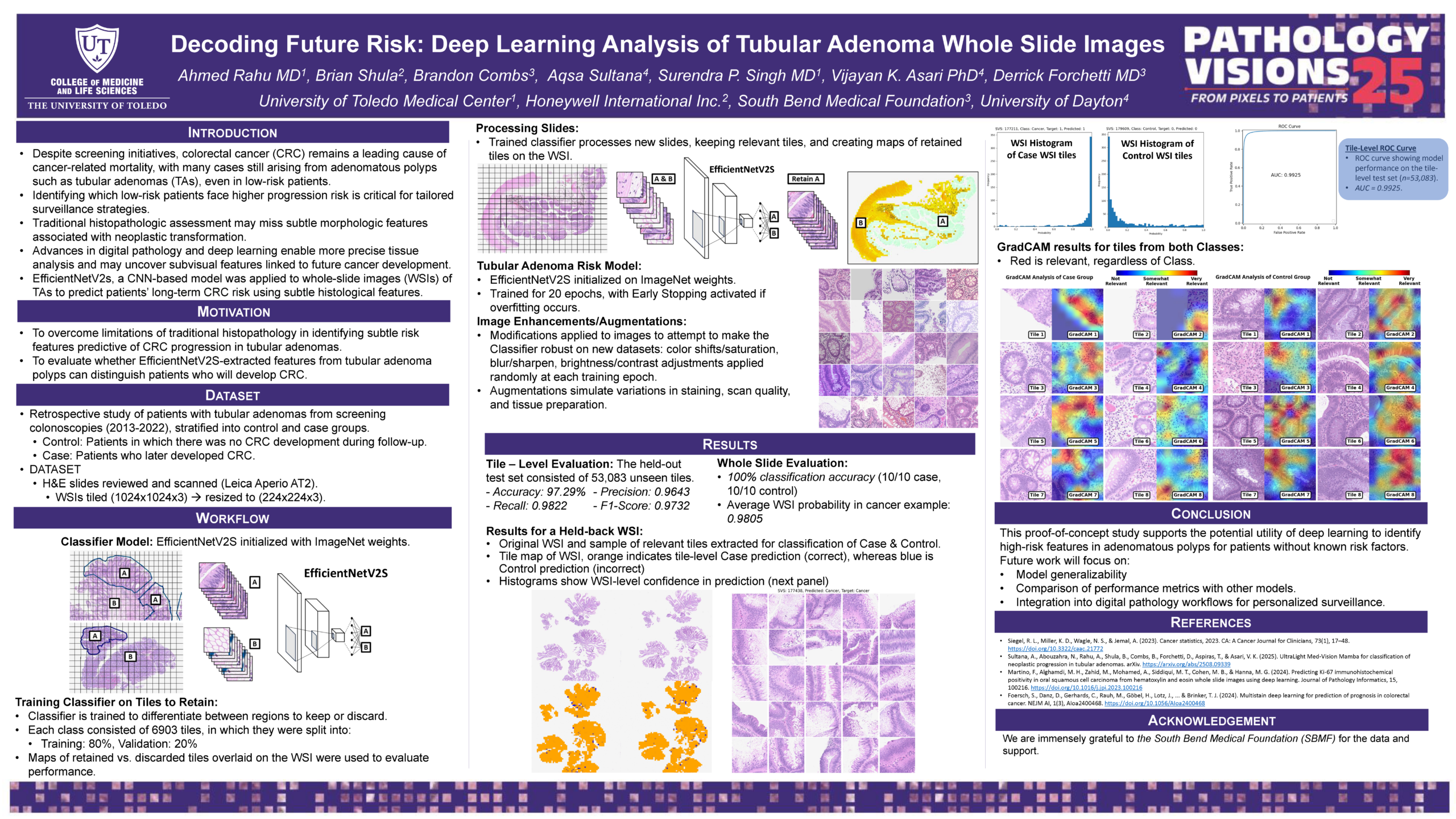
South Bend, IN, February 2026 — A collaborative research team—including South Bend Medical Foundation (SBMF) pathologist Dr. Derrick Forchetti and IT Architect Brandon Combs—has unveiled promising new results showing how cutting-edge artificial intelligence may one day help doctors identify patients at higher risk for developing colorectal cancer long before the disease emerges.
The work, presented at PathVisions 2025 and detailed in a companion research manuscript, explores whether advanced deep-learning models can detect extremely subtle warning signs hidden inside “ordinary-looking” precancerous colon polyps known as tubular adenomas.
Although these low-grade polyps are common and typically considered low-risk, some patients still go on to develop colorectal cancer later in life. Today, doctors have no reliable way to tell which of these patients might harbor microscopic risk features invisible to the human eye.
Using AI to See What the Human Eye Cannot
In partnership with the University of Dayton and University of Toledo, the team applied two state-of-the-art AI systems—EfficientNetV2S and a new “ultra-light” architecture called Med-Vision Mamba—to thousands of digital pathology image tiles provided by SBMF.
These models were trained to search for patterns so subtle that even expert pathologists could not reliably identify them.
Early findings are striking:
- The AI achieved over 97% accuracy in distinguishing patients who eventually developed colorectal cancer from those who did not.
- The models highlighted microscopic patterns in tissue structure that may represent early biological signals of future risk.
- Results were consistent even when evaluating entire whole slide images—an important milestone for real-world clinical use.
SBMF’s Role: Critical Data, Clinical Insight, and Scientific Leadership
Both Dr. Forchetti and Brandon Combs played essential roles in the success of the project:
- Derrick Forchetti, MD provided pathology expertise, guided interpretation of the AI-discovered patterns, and ensured clinical relevance.
- Brandon Combs supported digital pathology operations and data preparation, enabling the research team to work with the highest-quality images.
SBMF’s unique repository of expertly curated pathology slides made the study possible, giving researchers access to real-world specimens collected over nearly a decade.
Why This Matters
Colorectal cancer remains one of the nation’s leading causes of cancer-related death. Earlier and more precise identification of high-risk patients could:
- Personalize colonoscopy follow-up schedules
- Reduce unnecessary procedures
- Catch dangerous progression much earlier
- Ultimately save lives
If validated in larger studies, this technology could be integrated directly into routine digital pathology workflows—providing doctors with a powerful, AI-driven “second set of eyes.”
Looking Ahead
The research team plans to expand the dataset, test generalizability across institutions, and further refine how these AI insights can be used alongside traditional pathology.
SBMF is proud to contribute to a project that has the potential to transform cancer prevention and bring cutting-edge innovation into everyday patient care.